
18 November 2014
The Business Council of Co-operatives and Mutuals 2014 National Mutual Economy Report explores the contribution of co-operatives and mutuals to the Australian economy. The report lists Australia’s Top 100 co-operative and mutual businesses and creates a benchmark for monitoring the performance of the sector over the coming years.
Co-operatives and member owned businesses are an under recognised sector of the nation’s economy. Australia has 1700 member owned businesses providing numerous benefits to their 13 million members. We are pleased to highlight the contributions of co-operatives and mutuals and the ways in which they excel in creating shared value by reinvesting all profits back into the economy through their members.
– BCCM Chair and B20 Member, Dr Andrew Crane
Incorporating the Top 100 and Executive Insights Survey
Download: 2014 National Mutual Economy Report
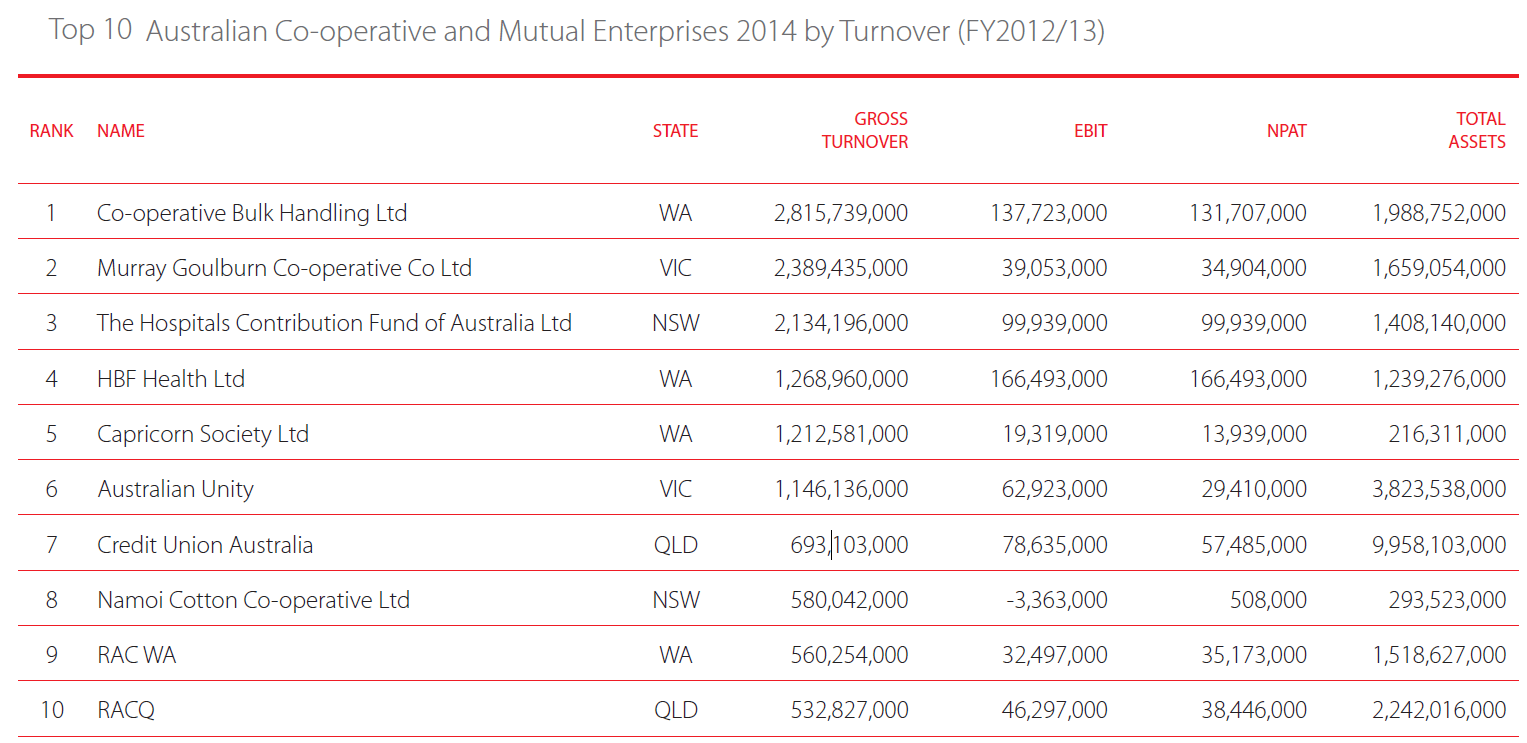
The Top 5 co-operative and mutual enterprises (by turnover):
- CBH Group (WA – $2.8 billion)
- Murray Goulburn Co-operative (VIC – $2.38 billion)
- HCF (NSW – $2.13 billion)
- HBF (WA – $1.27 billion)
- Capricorn Society (WA – $1.21 billion)
The Top 100 data is drawn directly from a study commissioned by the BCCM, which was undertaken by the University of Western Australia (UWA) and published separately in the UWA’s Australia’s Leading Co-operative and Mutual Enterprises 2014.
Media coverage
- Australia’s co-operative and mutual enterprises deserve greater recognition, The Conversation
- CBH Leads Nation, WA Business News
- Predicted resurgence in agricultural co-operatives as report finds value in member-owned business model, ABC Rural
- Aus Co-operatives A Hidden ‘Ninja’ Economy, Pro Bono News
Latest news

BCCM-EML Resilience dinner reflects on leadership and resilience across the co‑operative sector

CEO Strategy Roundtable focuses on economic pressures, competition and the future of mutual value