
Who is Deb Griesheimer?
Deb Griesheimer is the Manager of Caboolture Workers Co-op, a social enterprise dedicated to creating meaningful employment opportunities for people with cognitive disabilities. With extensive experience in stakeholder engagement, funding submissions, and purpose-driven enterprise development, Deb has played a key role in shaping the co-op’s success. But what drives her commitment to this work?
For Deb, the motivation is deeply personal. Reflecting on her return to the workforce after 15 years of raising children, she recalls:
“And then at the age of 45, I was back in the workforce. And I actually felt very unemployable.”
That experience of feeling disconnected and lacking confidence in her employability gave her firsthand insight into the barriers many workers face, particularly those with disabilities. It instilled in her a passion for creating employment opportunities that focus on dignity, capability, and inclusion.
How Caboolture Workers Co-op works
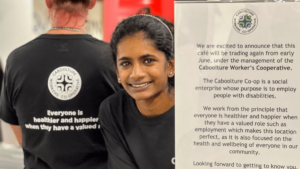
Caboolture Workers Co-op operates as a worker-led social enterprise. While structured as a co-operative, it also functions as a not-for-profit and registered charity. Its main enterprise is a café at Health Hub Morayfield, employing 14 workers with cognitive disabilities and providing over 150 hours of work each week.
The café is about more than just serving quality coffee and food – it’s about proving that inclusive workplaces can thrive. Deb explains:
The café provides a safe and supportive environment where workers develop skills, build confidence, and experience the dignity of employment.

The Bunya Fund project and collaboration with Nundah Community Enterprise Co-operative
Caboolture Workers Co-op has been working alongside the award-winning Nundah Community Enterprise Co-operative (NCEC) to build its capacity and sustainability. This collaboration has been made possible through support from The Bunya Fund of the BCCM, which fosters co-operative development through funding and peer learning.
NCEC has served as an inspiring model, demonstrating how a co-operative can create employment for people with disabilities while achieving financial sustainability. Through knowledge-sharing and mentorship, this partnership has helped Deb and her team refine their approach, strengthen governance, and expand opportunities for their workers.
Overcoming barriers: the co-operative way
Deb shared an example of how the co-op is breaking down barriers to employment:
“The work environment we’ve created closely resembles a mainstream café – it doesn’t look any different. Everyone is encouraged to be professional because we operate in a medical hub. That’s great learning for our members, and they’re not sheltered from the community.
In many traditional workplaces for people with disabilities, workers have been hidden away. But here, in an open environment, the community can see them achieving in their roles. One of our workers has a significant speech impediment, and over the past two years, we’ve watched how customers have learned to understand her. We’ve also introduced small prompts, like a chart she can point to when asking customers what type of milk they’d like.”
The co-op is intentional about the language it uses to empower workers:
- Supervisors, not support workers
- Members, not service users
- Workers, not participants
- Training, not helping
Another key principle is dignity of risk – ensuring that workers have the independence to make mistakes and learn from them.
“We focus on maximising their independence and allowing them to take risks, just as any worker would."
Five top collaborative leadership tips from Deb Griesheimer
Deb’s leadership at Caboolture Workers Co-op is deeply collaborative. Here are her five key insights on leading inclusively:
1. Listen deeply and value different perspectives
“You need to give people space to express themselves, even if it takes time. That’s how you build trust.”
2. Create employment with purpose
“It’s not just about having a job – it’s about having a role where you feel valued.”
3. Foster mutual learning
“We learn from each other every day. That’s the co-op way.”
4. Build structures that support rather than exclude
“If a workplace is designed only for high productivity and efficiency, you lose people along the way. We focus on creating systems that work for everyone.”
5. Celebrate every achievement
“For some of our workers, just being able to take an order confidently is a huge win. We celebrate those moments.”
What can mainstream workplaces learn?
Caboolture Workers Co-op challenges mainstream businesses to rethink employment. Deb’s story highlights how traditional work environments often exclude those who don’t fit the ‘ideal worker’ mould. By prioritising co-operation over competition and support over efficiency, the co-op proves that inclusive employment is both possible and beneficial.
A key aspect is strengths-based employment, where workers are matched to roles that align with their skills and interests.
“Some are really into making food, others are really into making coffee, and some are just fabulous at customer service. It’s about playing to their strengths."
A model for the future
Caboolture Workers Co-op is more than just a café – it’s a blueprint for what employment should look like. By creating an environment where people of all abilities can thrive, it offers a model that mainstream businesses can learn from and adopt.
As Antony McMullen of the BCCM reflected during the conversation:
“Sounds like what a good workplace should be, Deb. Playing to people's strengths – particularly important in your neck of the woods, but really, that’s what all workplaces should be doing.”
Deb agrees:
“Yeah, I think so. It would be ideal, wouldn’t it?”
The success of Caboolture Workers Co-op proves that when workplaces prioritise inclusion, dignity, and co-operation, they become stronger – not just for the workers, but for the entire community. With continued support from initiatives like The Bunya Fund and partnerships with organisations like NCEC, the future looks bright for co-operatives leading the way in inclusive employment.
Keep reading more stories

Keeping the tyres turning: Boyup Brook Co-op’s quiet blueprint for rural renewal
Growing together: Ceilidh Meo on co-operatives, olives and the power of patient collaboration