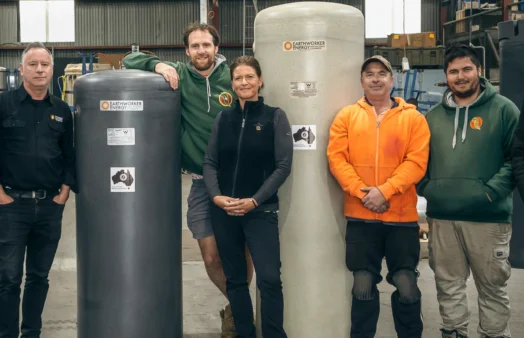

Karen Baines, the Executive Officer and a Director of Eyre Peninsula Co-operative Bulk Handling (EPCBH), brings a wealth of experience from various sectors to her role. Managing a grain and sheep enterprise with her family, working as a farm safety consultant, and engaging in renewables and hydrogen developments, Karen embodies the diverse expertise needed to lead EPCBH. Her commitment to sustainable agricultural practices and community-driven initiatives highlights the importance of co-operatives in regional development.
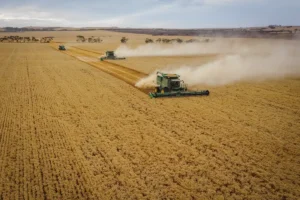
EPCBH was established in August 2017 to address competitiveness challenges for grain growers in South Australia’s Eyre Peninsula. Industry reports and Grain Producers SA surveys highlighted concerns about storage, handling costs, and limited export options. In response, EPCBH partnered with Iron Road Limited, developer of the Central Eyre Iron Project (CEIP), to enhance export opportunities and grower returns. A key focus is the Cape Hardy Port Development, a multi-commodity deep-sea port and infrastructure project approved by the South Australian government.

Personal motivation and EPCBH's mission
When asked about what personally motivates her work at EPCBH and the mission of the co-operative, Karen's passion was evident. she explained.
The Board of Directors, consisting of seven farmers and one independent director, collaborates with Iron Road, a mining company, to maximise the benefits for local farmers in Iron Road’s proposed multi commodity, deep seaport at Cape Hardy. "Our goal is to ensure that the farmers are not just spectators but active participants in the opportunities that the Cape Hardy Port presents," Karen added.
Karen shared how the co-operative came to be, highlighting the necessity of an alternative grain export facility. "We really needed another grain export facility on Eyre Peninsula because the only deep seaport export we have at the moment has an issue with social license around trucking grain through the main business district of Port Lincoln. It was originally built in the 1950s for 8-tonne trucks, and now we have AB triples running through that main shopping and business district. We need to rethink our transport and export routes for the future" she explained.
Co-operative Capital Units (CCUs)
Karen provided an insightful explanation of Co-operative Capital Units (CCUs) and their benefits for investment.
EPCBH utilised CCUs to purchase 160 hectares of land adjacent to Iron Road's property at the proposed port site. This strategic acquisition enabled EPCBH to develop a Master Plan, supported by The Bunya Fund, for an 'Agricultural Precinct.' "The precinct will host a grain accumulation site for export from the port and other complementary industries such as fertiliser distribution and a potential hydrogen refuelling station," Karen explained.
Karen elaborated on the process and challenges of utilising CCUs. "In 2021, we used cooperative capital units to buy a block of land that is adjoining the Iron Road land at Cape Hardy. We needed to raise money to purchase that land parcel and we did most of that via CCUs and some vendor finance. The CCUs enabled us to attract investment funds from people that aren’t members. This was important because it allowed us to bring in outside money while ensuring those investors couldn't vote in our cooperative or make changes," she said.
She also discussed the practical benefits and challenges of CCUs. "Both of the external groups that invested have businesses that could very likely play a role in the building of the port precinct and some of the infrastructure on our land."
Engaging diverse stakeholders
Working with a range of diverse stakeholders is a critical aspect of Karen's role. She approaches this task with a focus on communication and collaboration.
Karen's background in various sectors, including the fishing industry, trucking, and banking, has equipped her with the skills to navigate complex stakeholder dynamics. "In my 'spare time, I work as a farm safety consultant and engage in stakeholder activities around renewables and hydrogen developments. These experiences have taught me the importance of clear communication and compromise," she added.
Discussing the complexities of stakeholder engagement, Karen shared, "It's important to school the company wanting farm access on how to behave, where to drive, what to wear for safety, and make sure that the wishes of that farmer are respected. It’s about being assertive and not having a pity party over progress that you might not like. Engage with the group that is interested in whichever development and make sure you put across what you do and don’t like and what compromises may be possible."
Karen's role in stakeholder engagement also extends to her work with renewable energy projects. "EPCBH has been a bit of a conduit between renewables companies wanting to install turbines or solar. I don’t particularly like the turbines, but that’s the way the world is going. With the port development at Cape Hardy, there is an opportunity to investigate ammonia offtake from hydrogen production which would really benefit the fertiliser needs of our farmers. Through my role with EPCBH, I’ve met many people from within the renewable space which has also enabled facilitation of local student relationships with these companies.
"Ultimately, I would rather be assertive with progress and have a seat at the table to help steer us into a position that is going to be both beneficial, but also palatable to farmers."
Top three rules for engaging with stakeholders from EPCBH
- Ensure respect for member aspirations: "Make sure that the wishes of that farmer are respected."
- Engage and educate: "Educate yourself and engage with these companies and, you know, tell them ... how it is."
- Safeguard ownership: "You don't want someone trying to take over your business and infiltrate your co-operative and buy their way in with money."
The Bunya Fund's role
Karen highlighted the importance of The Bunya Fund in supporting EPCBH's initiatives.
Reflecting on the impact of the fund, Karen added, "It would have taken us another 12-18 months to get that done if we didn't have help from The Bunya Fund. Their support allowed us to develop a Master Plan for our block, which was an unusual request but essential for our progress."
Co-operative investment insights
Karen provided valuable insights into co-operative investment, highlighting the importance of strategic planning and community involvement. "You’ve got to think about things rationally and find common ground with stakeholders. It’s about making sure the views of farmers are understood and finding compromise where necessary," she said.
She also emphasised the role of creativity in co-operative investment. "We’re being very careful about our next steps. At the moment, we’re trying to make money from the land by leasing it for cropping and running sheep. We may also host a work camp for the Northern Water Desalination Plant, which will help us generate income," she explained.
Karen's approach to co-operative investment is characterised by a blend of traditional and innovative strategies.
Karen Baines’ journey with EPCBH illustrates the transformative potential of co-operatives in regional development. Her insights into co-operative investment, stakeholder engagement, and sustainable practices offer valuable lessons for anyone looking to champion co-operative growth and sustainability.
By fostering economic democracy through shared ownership and democratic decision-making, co-operatives like EPCBH address social and economic challenges while promoting environmental sustainability. The support from The Bunya Fund and the strategic use of CCUs have enabled EPCBH to take significant steps towards realising its vision of a thriving Agricultural Precinct at the proposed Cape Hardy Port.
Karen’s dedication to her work and her ability to navigate diverse stakeholder relationships underscore the importance of leadership in driving co-operative success. Her commitment to creating lasting, positive change in her community serves as an inspiration to others in the co-operative movement. Through collaboration, innovation, and a steadfast focus on community needs, EPCBH continues to pave the way for sustainable regional development.
As co-operatives look to the future, the lessons from EPCBH’s journey provide a blueprint for success. By understanding community needs, leveraging local opportunities, and fostering a culture of collaboration, co-operatives can create meaningful, lasting impact in their communities. With the right support and strategic planning, the potential for co-operatives to drive positive change is boundless.
Top three co-operative investment tips from EPCBH
- Understand your community needs: "The foundation of a successful co-operative is a deep understanding of the community’s needs and aspirations."
- Leverage local opportunities: "Identify and leverage local opportunities, such as developments at Cape Hardy Port, to benefit your co-operative."
- Utilise CCUs: "CCUs are a powerful tool for raising capital without compromising member control. They align financial contributions with co-operative principles."
Keep reading more stories
Keeping the tyres turning: Boyup Brook Co-op’s quiet blueprint for rural renewal
Growing together: Ceilidh Meo on co-operatives, olives and the power of patient collaboration