
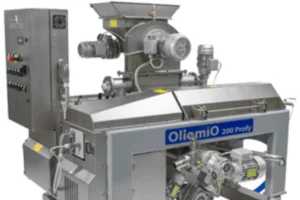
In the rolling hills north-west of Bendigo, a patchwork of small olive groves dots the landscape. Most were planted in the boom of the early 2000s; many have since changed hands, and a fair few have been quietly abandoned as owners discovered just how labour-intensive olives can be. Yet Apulia Grove – 2,500 trees tended by Ceilidh Meo and her husband, Charles – still hums with activity: Ivan the Invincible churns through kilos of fruit, barrels of table olives quietly ferment in the climate controlled strawbale processing shed, and blocks of unscented Castile soap cure on racks out of the sunlight in the back room.
Now Ceilidh is leading a bold next step, converting Apulia’s processing business into a multi-stakeholder co-operative that can serve (and be owned by) growers with anywhere from one backyard tree to three thousand. At the March 2025 Bunya Fund Community of Practice, she spoke with facilitator Antony McMullen about motivation, milestones and the reality of building a democratic enterprise while the harvest clock ticks.
-
What drives the move to co-operation?
Ceilidh’s answer begins at home. She grew up on a hobby farm steeped in her mother’s permaculture ethos: “It’s about helping people to help themselves,” she recalls. That childhood sense of grassroots mutual aid fused later with a practical frustration. As a contract processor she watched neighbour after neighbour walk away from groves because the economics simply did not work at small scale. “There had to be a better way to do it,” she decided. A chance conversation with co-operative adviser Claire Fountain led her to the Bunya Fund; an application went in “about a week before it was due”. Funding arrived, and with it a platform to test the conviction that solidarity could revive Central Victoria’s boutique olive industry.
-
From idea to steering committee
The first task was assembling the right people. Drawing on existing processing relationships, Ceilidh issued strategic invitations to growers who combined practical skills with an appetite for collaboration. That mix matters, she insists, because a co-op thrives on diversity of perspective as much as cash or acreage. She tells a story of organising an art exhibition with friends and realising the final show would be richer than any single person’s vision:
The steering committee now meets online across multiple time zones. Legal advice is in, a draft set of rules circulating, and a financial model – designed with Bunya Fund support – shows how education workshops, bulk-buy farm inputs, contract processing and an umbrella retail brand can all feed one balance sheet.
-
How will the co-operative work day-to-day?
Active membership will be defined by participation rather than scale. To qualify, a grower must own or manage up to 3,000 trees and do at least one of three things each financial year:
- deliver a minimum of 100 kg of fruit for processing,
- host or attend a co-op education workshop, or
- join at least one bulk-buy input order.
That design deliberately keeps the door open to hobbyist back-yarders (“two trees”) while anchoring the business in sufficient throughput to pay wages and invest in marketing. Members will vote, volunteer and – over time – share surpluses; non-members can still pay commercial rates for processing, giving the fledgling enterprise cash from day one.
Processing infrastructure, currently owned by Ceilidh and Charles, will be transferred to co-op ownership once the entity is fully capitalised – an elegant farm-succession strategy that ensures the factory remains locally controlled long after its founders retire.
Revenue will come from four streams:
- Contract processing – member and non-member fruit.
- Branded sales – extra-virgin oil, naturally fermented table olives and a line of super-fat unscented olive-oil soaps (“It’s great for shaving,” Ceilidh notes). The co-op is proactively exploring alternative income streams from traditional “waste” products of olive production, especially the pruned branches and twigs.
- Education and consultancy – pruning, organic pest control, soil health and small-batch fermentation, delivered through partnerships with CERES, neighbourhood houses and olive festivals, as well as on-farm field days aimed at small growers.
- Bulk-buy inputs – fertilisers, picking rakes and nets and food-grade barrels, purchased wholesale and re-sold at cost plus a modest margin. Capital outlay for small growers is cost-prohibitive in many cases, so having access to equipment for hire will increase productivity of the whole small scale sector.
-
The Bunya Fund effect
Small co-ops often stall at the same hurdle: the cost of professional advice and the volunteer hours required to herd dozens of busy members through legal and financial decisions. Ceilidh is unequivocal: “Without the support of The Bunya Fund, I don’t know that we would be this far down the track.” Bunya’s grant has paid for specialist co-operative lawyers to draft rules, an accountant to build cash-flow models that banks can understand, and a branding workshop scheduled the week after harvest. Perhaps more important, it has validated the idea in the eyes of would-be members and investors: if a national fund believes in the concept, growers are more willing to commit fruit, time and eventually equity.
-
Questions on the table
Plenty remain. How much olive oil will the co-op need to handle before it can hire paid staff instead of relying on volunteers? Should surplus oil be bought outright from members or pooled under a profit-share? And can they hit next year’s farmers-market season with a fully-fledged retail brand?
Those questions won’t be answered in a single committee meeting, but Ceilidh seems unfazed. Her mantra comes from an African proverb she quoted near the end of the session:
Five top tips from Ceilidh Meo
- Spot the gap and act quickly
“There has to be a better way to do it.”
- Curate your founding team
“There was a bit of a strategic invitation… and that has actually played out really well.”
- Trust collective intelligence
“The whole is always greater than the sum of the parts.”
- Diversify your products
“We make olive-oil soap, we’ve carefully cultivated niches – small-scale processing, unscented soap, naturally fermented olives.”
- Find external support
“Without the support of The Bunya Fund I don’t know that we would be this far down the track.”
Looking ahead
Harvest waits for no steering committee, so formal incorporation will pause until the last bin of fruit is pressed. After that, the co-operative will sprint towards a July rule-lodgement date, an autumn education calendar and a spring marketing launch. By next season, if all goes to plan, Central Victorian consumers could be stirring locally grown, co-operatively bottled extra-virgin oil into their pasta – proof that, with a little help and a lot of solidarity, small growers can thrive together where they might fail alone.
Ceilidh’s journey is still in its early chapters, but the lessons are already clear: start with shared values, build workable rules and never underestimate the catalytic power of a timely grant. The wider co-operative movement will be watching – perhaps with a bar of olive-oil soap in one hand and a jar of kalamatas in the other.
Keep reading more stories
Keeping the tyres turning: Boyup Brook Co-op’s quiet blueprint for rural renewal
Solidarity in action: Colin Long on a lifetime of co-operation, climate justice and the power of The Bunya Fund